Case Study: Conservative Management of Multilevel Lumbar Spondylolisthesis With Long-Term Functional Improvement
A woman in her late sixties with multilevel lumbar spondylolisthesis experienced chronic pain, cramping, and reduced mobility. This observational case study explores conservative management, multidisciplinary care, rehabilitation, and long-term functional improvement without structural correction.
Case Study: Multilevel Lumbar Spondylolisthesis Managed Conservatively With Long-Term Functional Improvement
Background
Lumbar spondylolisthesis can present with chronic pain, reduced mobility, intermittent neurological symptoms, and functional limitation. Management is often individualised and may involve a combination of education, rehabilitation, manual therapy, medical management, and specialist follow-up depending on symptom severity and patient-specific factors.
This observational case describes a patient with multilevel lumbar spondylolisthesis who pursued conservative management over several years with the goal of improving function and quality of life rather than correcting the underlying structural changes.
Patient Presentation
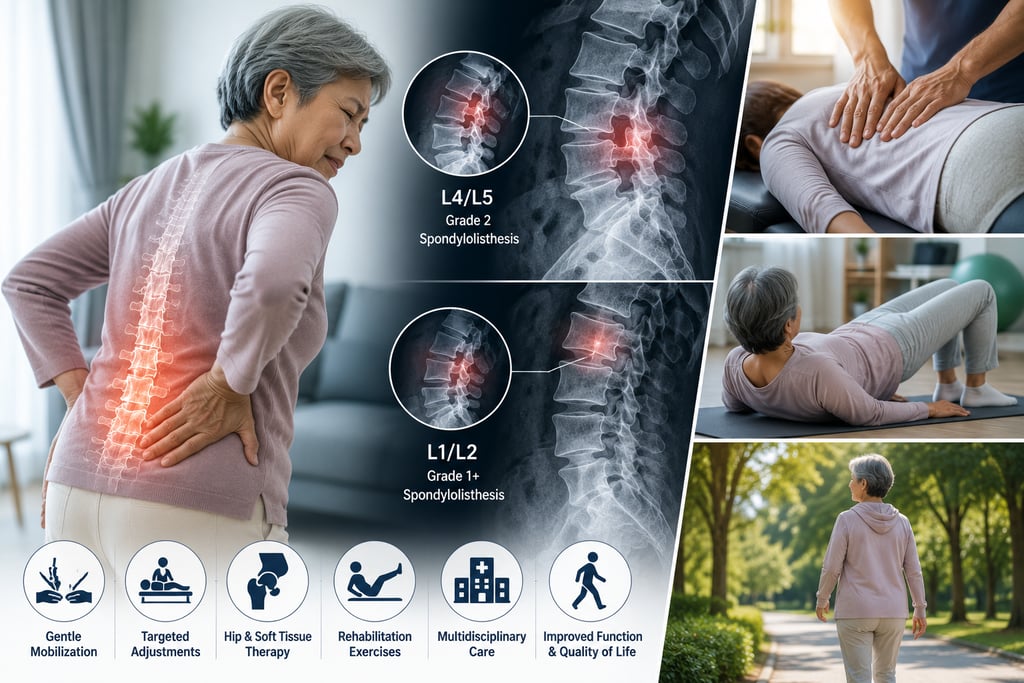
A woman in her late sixties presented with longstanding lower back pain and imaging demonstrating multilevel lumbar spondylolisthesis involving the L4–L5 and L1–L2 levels.
Available radiographs suggested approximately Grade II vertebral slippage at L4–L5 together with milder slippage at L1–L2.
Before attending the clinic, the patient had undergone physiotherapy without meaningful improvement and had also pursued traditional treatment elsewhere, after which symptoms reportedly worsened.
The patient described increasing pain, intermittent lower-limb numbness, cold sensations in the legs, and cramping that interfered with walking and daily activities.
Conservative Management
Because of the patient's symptoms and presentation, management began cautiously.
The initial phase emphasised gentle mobilisation and symptom-guided care with the aim of reducing muscular guarding, improving movement tolerance, and facilitating gradual functional recovery.
As symptoms stabilised over subsequent visits, carefully selected low-amplitude manual techniques and supportive rehabilitation strategies were introduced in accordance with patient tolerance.
Hip mobility interventions, soft tissue management, and progressive exercises were later incorporated to encourage improved movement patterns and functional capacity.
Throughout care, expectations were discussed openly, including the understanding that conservative treatment was intended to optimise function and symptom management rather than reverse the structural vertebral slippage.
Functional Progress
Over time, the patient reported meaningful improvements in mobility and confidence with walking.
Episodes of lower-limb cramping became less frequent, walking tolerance increased, and everyday activities such as light household tasks became easier to perform.
Although intermittent symptoms persisted, overall function improved sufficiently that follow-up intervals were progressively extended and ongoing management became primarily as needed rather than on a frequent basis.
The patient was encouraged to continue prescribed exercises and remain physically active within comfortable limits.
Multidisciplinary Care
During the course of management, the patient was also assessed within the public healthcare system and received additional medical treatment, including injection-based therapy as recommended by the treating specialists.
Following these interventions, the patient reported further reduction in pain and improved mobility.
According to the patient, orthopaedic assessment concluded that surgical intervention was not considered an appropriate option because of individual medical considerations, making long-term conservative management the preferred strategy.
Long-Term Follow-Up
Approximately one year after substantial improvement, the patient reported recurrence of intermittent cramping during periods of increased activity.
Despite these fluctuations, overall daily function remained considerably better than before presentation.
The patient continued to attend periodically for reassessment and supportive conservative care when symptoms became more troublesome.
This pattern reflected the chronic nature of the underlying condition and the expectation that symptom severity may vary over time.
Clinical Reflection
This case illustrates that conservative management of multilevel lumbar spondylolisthesis may focus on improving mobility, reducing symptom burden, and enhancing quality of life rather than correcting structural alignment.
It also highlights the importance of realistic expectations, multidisciplinary collaboration, and long-term self-management strategies in patients with chronic spinal conditions.
Improvements observed in this case occurred within the context of combined rehabilitation, medical management, exercise, and ongoing specialist involvement. Accordingly, no single intervention can be identified as solely responsible for the patient's outcome.
Key Clinical Lessons
Structural spinal changes do not always require surgical management when surgery is not appropriate or feasible.
Conservative care may help improve function and symptom tolerance in selected patients.
Multidisciplinary management can play an important role in chronic spinal conditions.
Long-term rehabilitation often focuses on quality of life and functional capacity rather than structural correction.
Chronic symptoms may fluctuate over time, requiring ongoing self-management and periodic reassessment.
Important Disclaimer
This anonymised observational case is presented for educational purposes only.
The patient described had documented multilevel lumbar spondylolisthesis and received care from multiple healthcare providers over an extended period. Reported improvements occurred in the context of combined conservative rehabilitation, medical interventions, exercise, and specialist management.
This case should not be interpreted as evidence that chiropractic treatment corrects vertebral slippage or guarantees similar outcomes in other individuals. Management decisions should always be individualised based on imaging findings, symptoms, neurological status, overall health, and specialist recommendations.