Case Study: Progressive Neurological Deterioration in a Young Adult With Suspected Cauda Equina Involvement
A 22-year-old man presented with severe functional limitation, a markedly flexed posture, bilateral neurological findings, reduced reflexes, and loss of bladder control. According to the patient, rapid deterioration developed within two days of a previous chiropractic treatment. This observational case explores suspected cauda equina involvement, the difference between temporal association and proven causation, the limitations of temporary symptom relief, and the importance of timely medical referral.
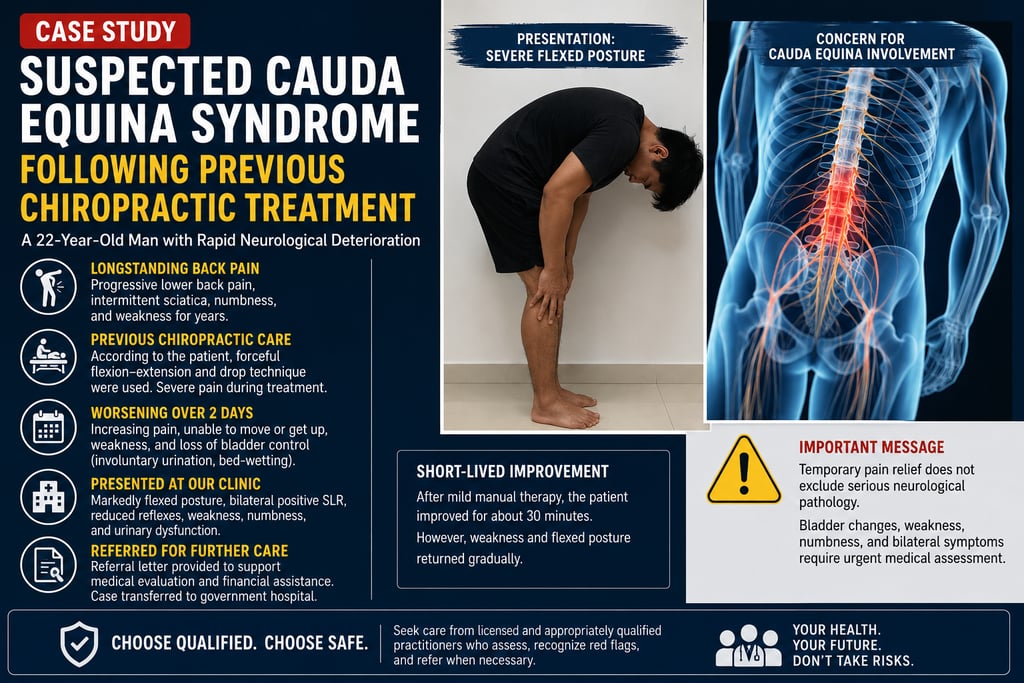
Case Study: Progressive Neurological Deterioration in a Young Adult With Suspected Cauda Equina Involvement
Background
Lower back pain is common, but lower back pain accompanied by progressive neurological dysfunction requires a very different level of clinical attention.
Cauda equina syndrome is a serious neurological condition involving dysfunction or compression of the nerve roots within the lower spinal canal. Presentations can vary, but concerning features may include progressive lower-limb weakness, altered sensation, reduced reflexes, bilateral leg symptoms, saddle sensory disturbance, and changes in bladder or bowel function.
This anonymised observational case describes a 22-year-old man with a longstanding history of lower back symptoms who experienced significant neurological deterioration over a short period and later presented to the clinic with severe functional limitation.
The case also demonstrates an important clinical lesson: temporary improvement in pain and movement does not necessarily indicate that a serious underlying neurological condition has resolved.
Patient Presentation
A 22-year-old man attended the clinic seeking another opinion regarding severe lower back symptoms and major functional limitation.
When he entered the clinic, his trunk was markedly flexed forward. He had considerable difficulty standing upright and walked in a severely flexed posture.
The patient attended with the hope of understanding whether anything could still be done to help his situation.
His history revealed that the condition had developed over several years but had undergone a much more severe deterioration following a recent sequence of events.
Earlier Injury History
The patient's history reportedly began approximately six to seven years earlier.
He recalled falling while performing exercises on monkey bars and landing directly onto his buttocks.
According to the patient, the pain immediately following the fall was not particularly severe. He was able to continue with his life, but over the following years, lower back symptoms gradually became more troublesome.
Before the episode of major deterioration, the patient reported experiencing:
Progressive lower back pain
Intermittent sciatica
Episodes of numbness
A feeling of weakness around the lower back
Gradual worsening of physical tolerance
The patient therefore had a pre-existing history of progressive lower back symptoms before the later episode of rapid deterioration.
This distinction is important because the exact underlying structural condition present before the deterioration was unknown.
Reported Previous Chiropractic Treatment and Subsequent Deterioration
At a later stage, the patient sought chiropractic care elsewhere for his worsening lower back symptoms.
According to the patient's account, the treatment involved forceful flexion and extension-type movements together with the use of a drop-table technique.
The patient described the treatment as physically rough and reported experiencing severe pain during the treatment session itself.
According to his history, his condition progressively deteriorated over approximately the following two days.
He reported becoming increasingly weak and having considerable difficulty moving, standing, and getting up.
The patient subsequently developed symptoms concerning for significant neurological involvement.
Most importantly, he reported loss of bladder control, including involuntary urinary leakage and frequent episodes of bed-wetting.
The close temporal relationship between the reported treatment episode, severe pain during treatment, and subsequent deterioration over approximately two days was considered clinically relevant.
However, the available information does not allow a definitive conclusion that the previous treatment directly caused the neurological deterioration.
The patient already had a longstanding history of progressive lower back pain, intermittent sciatica, numbness, and weakness. No accessible imaging from immediately before and after the reported deterioration was available for comparison.
Therefore, the most appropriate interpretation is that significant neurological deterioration was reported by the patient to have occurred shortly after the previous treatment episode.
Aggravation of an existing underlying lumbar condition could not be excluded. However, a direct causal relationship could not be established from the information available.
Presentation at Our Clinic
By the time the patient attended our clinic, his functional presentation was significantly impaired.
He walked with his trunk markedly flexed forward and was unable to comfortably maintain an upright standing position.
Clinical assessment identified several concerning findings, including:
Markedly flexed standing and walking posture
Inability to maintain an upright position
Bilateral positive Straight Leg Raise findings
Reduced lower-limb reflex responses
Subjective weakness
History of intermittent sciatica
History of numbness
Severe functional limitation
Reported loss of urinary control
Taken together, the history and examination findings raised serious concern for significant neurological involvement affecting the lower lumbar or lumbosacral nerve structures.
The combination of bladder dysfunction, bilateral neural tension findings, reduced reflex responses, weakness, and severe functional deterioration was particularly concerning for possible cauda equina involvement or another serious lumbosacral neurological condition requiring further medical investigation.
Conservative Intervention and Short-Lived Response
During the visit, limited muscle work and a very mild manual intervention using an MVLA approach were performed.
The intervention was intentionally conservative.
Initially, the patient's response appeared encouraging.
For approximately 30 minutes, the patient reported substantial symptomatic relief and demonstrated noticeably improved movement.
He appeared considerably more comfortable and was extremely pleased with the immediate change. At that moment, he was able to move with greater confidence and expressed gratitude for the relief he experienced.
However, the improvement was not sustained.
After approximately 30 minutes, the patient gradually began returning to the flexed posture.
Weakness and difficulty maintaining an upright position became apparent again, and the initial functional improvement progressively diminished.
The patient eventually returned toward the same flexed position in which he had initially presented.
This short-lived response became an important clinical observation.
Although pain and movement had temporarily improved, the underlying neurological presentation had clearly not resolved.
Why Temporary Improvement Did Not Resolve the Clinical Concern
This case illustrates an important distinction between temporary symptomatic improvement and neurological recovery.
Pain intensity, muscular guarding, and movement tolerance may sometimes change temporarily even when significant underlying pathology remains present.
A short period of pain reduction does not establish that neurological compression or dysfunction has resolved.
In this case, the return of weakness, postural collapse, and inability to maintain an upright position after a brief period of improvement reinforced the concern that the patient required further medical investigation beyond symptomatic conservative care.
The temporary improvement was therefore not interpreted as resolution of the underlying condition.
This remains one of the most important lessons from the case.
Referral and Continuation of Care
The patient's presentation required further medical investigation and management beyond the scope of conservative musculoskeletal care.
The last known development in the case involved the patient's father returning to the clinic and requesting a formal referral letter and supporting clinical documentation.
The family faced significant financial limitations and relied primarily on farming for their livelihood.
According to the family, the young man was expected to become an important future source of financial support. He had been able to continue his studies and was preparing to enter employment before the severity of his condition significantly affected his function.
The father requested documentation to support the patient's continuation of medical care and to assist the family in seeking available financial support.
The necessary referral documentation was provided, and the case subsequently entered the government hospital system.
After the patient's care was transferred, no subsequent imaging, specialist reports, treatment details, surgical information, or long-term outcome data were available to our clinic.
For this reason, the final hospital diagnosis and long-term outcome cannot be reported in this case study.
Clinical Reflection
This case remains memorable because of the severity of the patient's functional deterioration at such a young age.
The patient had a longstanding history of lower back symptoms following an earlier fall, followed years later by a much more rapid deterioration.
According to his account, severe pain occurred during a previous treatment session and was followed by progressive loss of function over approximately two days, together with significant bladder dysfunction.
The temporal relationship between those events deserves accurate documentation, but it should not be confused with proof of causation.
Without access to imaging immediately before and after the deterioration, specialist findings, or subsequent hospital records, it is impossible to determine whether the progression represented:
Natural worsening of pre-existing pathology
Acute aggravation of an existing lumbar lesion
Progression of disc-related pathology
Another compressive neurological process
Or another mechanism that could not be determined from the available information
The case also reinforces another important clinical lesson.
An impressive immediate response to treatment does not necessarily indicate that serious underlying pathology has resolved.
In this case, the patient experienced meaningful improvement for only a short period before weakness and postural collapse returned.
In complex neurological presentations, clinical decisions must therefore be based on the complete history, neurological findings, symptom progression, and appropriate medical investigation rather than immediate pain response alone.
Key Clinical Lessons
A detailed clinical history should establish the patient's condition both before and after any reported episode of deterioration.
Bladder dysfunction associated with progressive lower back and neurological symptoms requires serious attention.
Bilateral neural tension findings, reduced reflexes, weakness, and major functional deterioration may indicate significant neurological involvement.
A close temporal relationship between an intervention and deterioration should be documented accurately, but temporal association alone does not establish causation.
Temporary pain relief or improved movement does not exclude serious underlying neurological pathology.
Immediate symptom improvement should never override significant neurological findings.
When a clinical presentation exceeds the appropriate scope of conservative care, further medical investigation and referral are essential.
Long-term outcome claims should not be made when specialist reports and follow-up information are unavailable.
Important Disclaimer
This anonymised observational case is presented for educational purposes only.
The history regarding the patient's previous treatment and subsequent deterioration was based on information reported by the patient.
No claim is made that the previous intervention definitively caused the patient's neurological deterioration.
The close temporal relationship between the reported treatment, severe pain during the session, and neurological deterioration over the following two days is documented as part of the patient's reported clinical history.
The clinical presentation raised concern for possible cauda equina involvement or another significant lumbosacral neurological condition.
However, because subsequent government hospital imaging, specialist reports, and long-term follow-up information were not available to the clinic, this article does not claim a confirmed final diagnosis.
The brief symptomatic improvement described in this case should not be interpreted as evidence that manual therapy treats or resolves cauda equina syndrome.
Cauda equina syndrome is a medical emergency. New bladder or bowel dysfunction, saddle-area sensory changes, or progressive neurological weakness associated with lower back symptoms require urgent medical assessment.
Patient Safety Remark
This case also highlights the importance of seeking musculoskeletal and chiropractic care from appropriately qualified and licensed practitioners.
Chiropractic treatment and spinal manipulation should never be approached as a routine procedure applied in the same manner to every patient.
Appropriate clinical care begins with thorough history-taking, physical examination, neurological assessment where indicated, consideration of contraindications, responsible technique selection, and recognition of situations that require imaging, medical investigation, specialist involvement, or urgent referral.
The purpose of sharing this case is not to suggest that chiropractic treatment commonly causes serious neurological complications, nor is it intended to assign responsibility for this patient's outcome.
In this case, the exact mechanism of deterioration could not be established because comparative imaging and subsequent specialist records were unavailable.
However, patients should be cautious about receiving forceful spinal treatment without appropriate assessment or from individuals who are not appropriately trained, qualified, and licensed to provide such care.
Patients should seek care from practitioners who work within their professional scope, maintain appropriate clinical standards, communicate clearly, recognise their limitations, and refer patients when the presentation requires medical or specialist investigation.
Safe clinical practice is not defined by how forceful, dramatic, or impressive a treatment appears.
It is defined by proper assessment, responsible clinical reasoning, appropriate patient selection, careful technique selection, informed decision-making, and knowing when treatment should not proceed.
When neurological symptoms such as progressive weakness, loss of sensation, saddle-area sensory changes, or changes in bladder or bowel control are present, urgent medical assessment should take priority over continued manual treatment.