Persistent Buttock and Leg Pain Associated With Piriformis Region Involvement
Explore an observational clinical case study of persistent buttock and leg pain associated with piriformis region involvement, conservative management, rehabilitation, and patient-reported recovery.
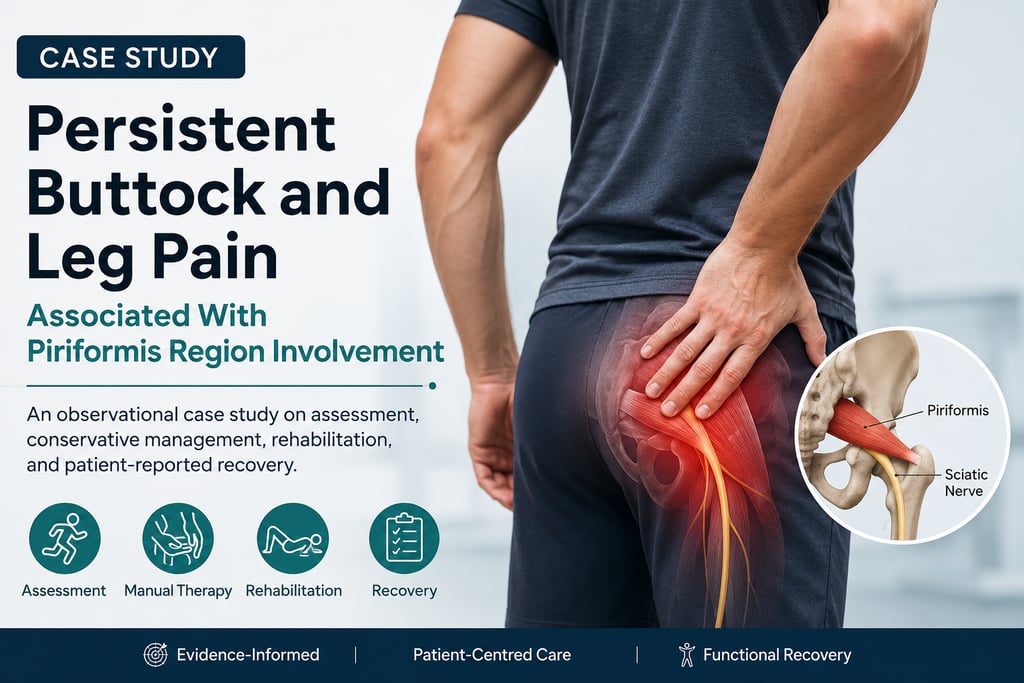
Case Study: Persistent Buttock and Leg Symptoms Associated With Deep Gluteal Region Irritation — An Observational Conservative Management Report
Background
Persistent buttock and leg pain can arise from a variety of musculoskeletal and neurological conditions, including lumbar spine disorders, deep gluteal region pathology, peripheral nerve irritation, and movement-related dysfunction. Because these presentations often overlap, careful history-taking, physical examination, and ongoing reassessment are essential.
This case describes the presentation of a physically active adult with progressive buttock and lower-limb symptoms managed conservatively in conjunction with subsequent orthopaedic review.
This report is presented for educational purposes and should not be interpreted as proof of diagnosis or treatment effectiveness.
Patient Presentation
A male in his early thirties employed in the automotive industry as a technician presented with progressively worsening pain involving the buttock and lower limb.
Approximately one year before presentation, the patient experienced intermittent discomfort around the hip and buttock region. Initially infrequent, symptoms gradually became more persistent and extended into the lower back and lower limb while the patient continued performing physically demanding occupational duties.
By the time of presentation, the patient reported:
Significant pain during walking and weight-bearing
Burning discomfort over the buttock region
Difficulty standing upright
A sensation of weakness in the affected leg
Tightness and heaviness around the ankle
Reduced walking tolerance
Protective leaning while walking
Difficulty sitting comfortably on the affected side
The progressive symptoms substantially affected daily activities and occupational function.
Clinical Assessment
A focused musculoskeletal examination was performed.
Documented findings included:
Sharp buttock pain reproduced during single-leg loading
Pain described as aching, throbbing, and intermittently burning
Localised tenderness over the deep gluteal region
Difficulty maintaining an upright posture due to discomfort
Orthopaedic examination findings included:
Kemp test: Negative
Straight Leg Raise: Negative
FAIR test: Positive with reproduction of buttock pain
Standing FAIR position: Reproduction of discomfort with associated tingling
Direct palpation over the piriformis region reproduced marked local pain with referral into the lower limb
Clinical findings raised consideration of significant involvement of the piriformis region and surrounding deep gluteal structures.
Given symptom severity, localised tenderness, functional limitation, and symptom behaviour, local tissue irritation was considered one possible contributor. However, no structural injury was confirmed, and no imaging findings were available for review.
The examination findings were considered observational and not diagnostic in isolation.
Additional Medical Assessment
Between the first and second conservative management visits, the patient reported attending an orthopaedic consultation.
According to the patient, the clinical impression communicated at that visit suggested symptoms may have been consistent with piriformis region involvement and associated lower-limb symptoms commonly described as sciatica.
No imaging findings were available for review; therefore, structural conclusions cannot be drawn within this report.
Conservative Management
A multimodal conservative management plan was initiated and individualised to the patient's presentation.
Interventions included:
Gentle joint mobilisation
Selected manual therapy techniques
Soft tissue management
Trigger point-focused treatment
Progressive movement advice
Home exercise prescription
Activity modification guidance
Adjunctive supportive modalities
Following the initial visit, the patient reported improved walking confidence and reduced symptom intensity, although mild burning discomfort and perceived weakness remained.
Subsequent Follow-Up
Several days later, the patient reported increased discomfort around the ankle during weight-bearing.
Given the prolonged history of limping and altered loading patterns, secondary biomechanical compensation affecting the lower limb was considered a possible contributing factor.
Management was modified accordingly, after which the patient reported improved weight-bearing tolerance.
During recovery, the patient also developed an unrelated viral illness associated with temporary symptom aggravation. Following medical care and recovery from the illness, symptoms gradually improved.
Ongoing Recovery
At approximately six weeks after subsequent review, the patient reported substantial overall improvement in buttock and leg symptoms.
Residual findings included:
Mild protective sitting posture
Continued preference for asymmetrical loading
Reduced confidence in fully resuming normal movement
A structured home exercise programme and postural retraining were reinforced.
At a later review, the patient reported symptoms affecting the opposite lower limb. During discussion, the patient acknowledged inconsistent adherence to the prescribed exercise programme because of concern that movement might reproduce previous pain.
Additional education regarding gradual loading, movement confidence, and exercise progression was provided.
During subsequent follow-up communication, the patient reported that symptoms improved after implementing the recommended exercises and postural modifications.
The patient elected not to continue formal follow-up visits but later communicated that he was generally functioning well.
Clinical Discussion
Deep gluteal region pain and associated lower-limb symptoms may involve multiple interacting factors and can be challenging to distinguish from lumbar spine or peripheral nerve disorders based on clinical examination alone.
This case demonstrated patient-reported improvement over time following conservative management, activity modification, and progressive exercise.
However, several alternative explanations remain possible, including:
Natural recovery
Changes in occupational loading
Behavioural adaptation
Reduced exposure to aggravating activities
Medical management received elsewhere
Multifactorial recovery processes
Accordingly, this report does not establish diagnosis, causation, or treatment efficacy.
Key Clinical Lessons
Persistent buttock and lower-limb pain requires careful assessment and consideration of multiple potential contributors.
Clinical examination findings should be interpreted within the broader context of patient history and ongoing reassessment.
Long-standing compensatory movement patterns may influence symptom persistence and recovery.
Patient education, gradual exercise progression, and adherence to rehabilitation recommendations may be important components of conservative management.
Improvement in an individual case should not be interpreted as evidence that similar outcomes will occur in other patients.
Important Disclaimer
This article describes a single observational clinical case for educational purposes.
Clinical details have been anonymised and modified where appropriate to preserve patient privacy.
The findings described represent one patient's presentation and reported experience. They do not confirm a structural diagnosis, including muscle tear, nor do they establish that any intervention was responsible for the observed outcome.
No imaging findings were available for review in this case.
Individual presentations vary considerably, and readers experiencing persistent buttock pain, progressive leg symptoms, weakness, numbness, or changes in bladder or bowel function should seek prompt assessment by an appropriately qualified healthcare professional.
This case study should not be interpreted as medical advice or as a guarantee of treatment outcome.